#What we ask permission for
The first time you sign in, Resonate asks one question: may we record how you use the app? If you say yes, we note which parts you use and when — for example starting a track, saving something to your library, running a search, or opening a listing. These signals can help improve discovery and recommendations, show artists aggregate patterns, reveal which features are useful, and guide what Resonate builds next. If you choose to share your city with a show pledge, we can use that city and the confirmed pledge in aggregate artist demand insights. We never infer your location from an IP address, wallet or campaign city.
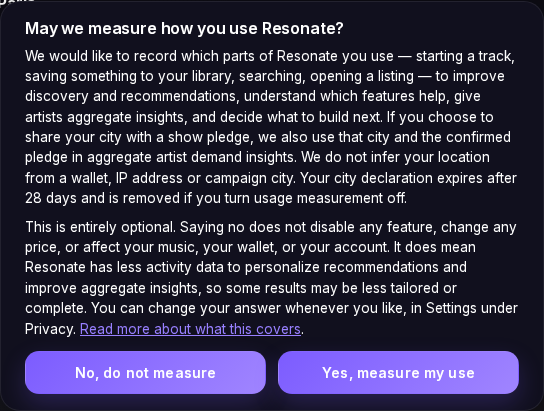
- We ask before anything is recorded. Until you answer, nothing about how you use the app is collected.
- This is about how you use Resonate, not about who you are or what you say.
- Your purchases, uploads, and payouts are kept whatever you choose, because they are records of things that actually happened — a sale, a release, a payment.
#Saying no is a real option
Refusing is exactly as easy as accepting. Saying no does not disable features, change prices, or affect your music, wallet, purchases, or account. Discovery and recommendations still work, but Resonate has less activity data to personalize them or produce aggregate insights, so some results may be less tailored or complete.
#Changing your answer later
Your answer is never final. Open Settings and choose Privacy: it shows what you chose and lets you switch it either way, as often as you like. Turning it off stops the collection from that moment, removes optional pledge city declarations, and also deletes the usage records already collected under your earlier yes. Deletion is carried out by a scheduled clean-up, so it normally finishes within a day and is retried if a system is temporarily unavailable; records of things that actually happened, such as payments, remain. Pledge city declarations expire after 28 days even if you keep measurement on.
- Open Settings.
- Choose Privacy in the list of sections.
- Pick 'Measure my use' or 'Do not measure'. The change takes effect straight away.
#Why we might ask you once more
We only ask again if what we collect changes in a way that matters. Your earlier answer covered what we described at the time, so a real change means the question has to be put to you again — with the new wording in front of you. We will not re-use an old yes to cover something new, and we will not nag you about wording tweaks.
If the wording happens to change while the question is on your screen, we will show it again rather than record your answer against text you did not read.